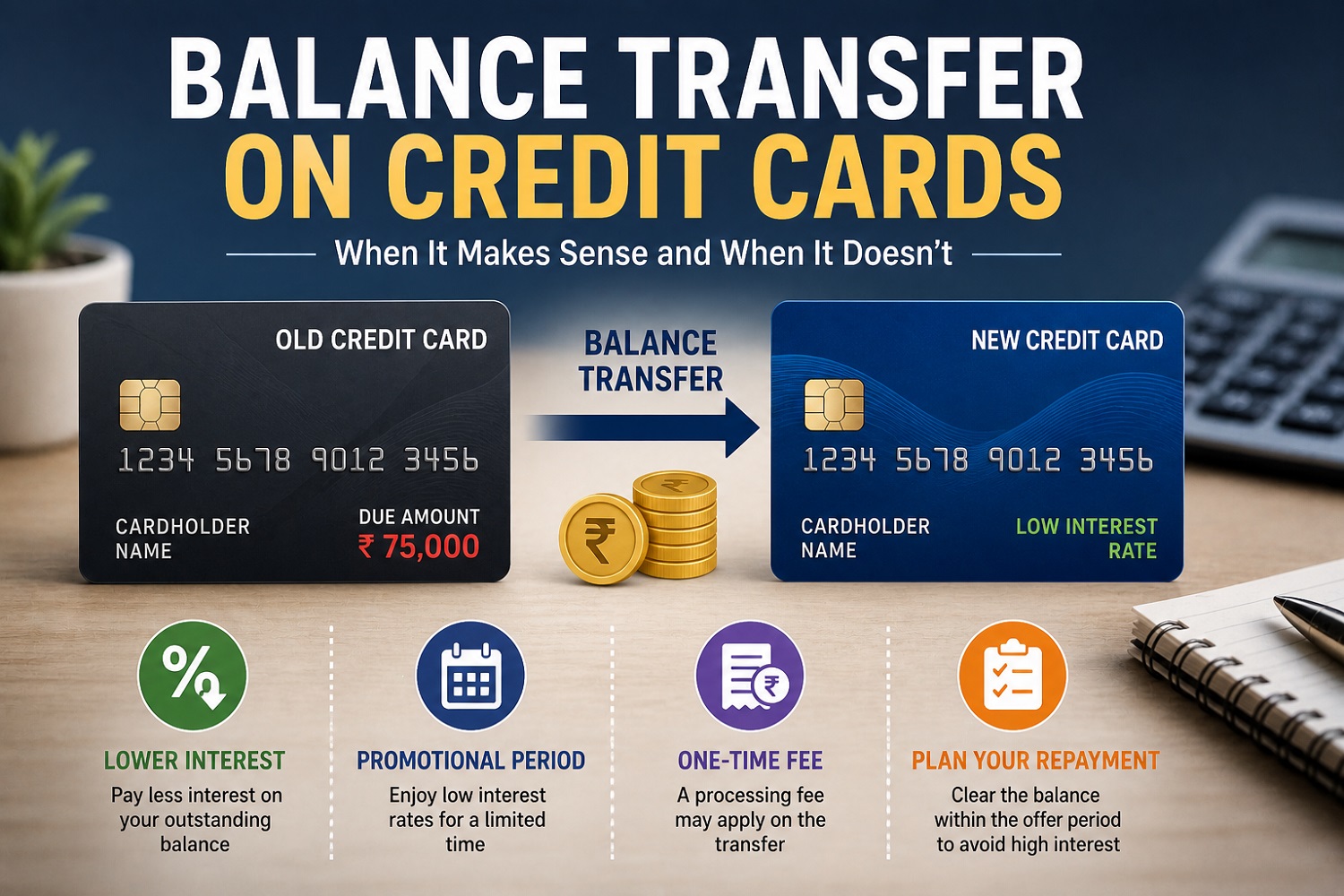
How many people prefer balance transfer on credit cards? The reality is a big chunk of the credit card holders don’t have a clear concept about it.
Actually, it is a feature that allows you to move your outstanding balance from one credit card to another. And, usually, it happens at a lower interest rate.
It is often regarded as a meaningful strategy to decrease interest costs and manage existing debt more effectively.
How Balance Transfer Works
When you go for a balance transfer, your new card issuer pays off the outstanding amount on your old card. And the same amount is added to your new card balance.
Notably, many banks choose to offer promotional interest rates for a limited period. This rate can be significantly lower than the regular credit card interest rates.
However, one essential fact is balance transfers are not free. Most banks charge a processing fee, and the lower interest rate is usually valid only for a fixed tenure. And after the promotional period ends, the standard interest rate applies.
When Balance Transfer on Credit Cards Makes Sense
Obtaining the scope of balance transfer on credit cards can be beneficial if you are currently paying high interest on your existing credit card. Also, if the new card offers a lower rate and the savings outweigh the processing fee, then the balance transfer feature can help decrease your total repayment amount.
On the other hand, this feature can be a remarkable choice if you have a clear repayment plan. Yes, the balance transfer can give you breathing room to pay off your dues. And, you can do this without accumulating heavy interest, especially if you use the low-interest period effectively.
When It Doesn’t Make Sense
The above discussion has revealed the positive side of the balance transfer. However, it may not be suitable for everyone.
You should know one simple truth: if you continue to spend on your old or new card without clearing the transferred balance, then you may ultimately result in an increased overall debt. Now, in these cases, the desired benefit of lower interest is lost.
Furthermore, if the processing fee and other charges are high, then the savings may not be significant.
Importantly, transferring balances repeatedly without creating any proper repayment plan can also create a cycle of debt.
Key Points to Consider
Alwayscheck the interest rate, processing fee and tenurebefore choosing a balance transfer on credit cards. Even don’t forget to check whether there are any hidden charges in the path.
Also, it is necessary that you don’t limit yourself only to focusing on the promotional rate. Make sure that you understand the total cost involved in balance transfer processing.
Final Thoughts
Balance transfer on credit cards can be a useful financial tool only when you use the feature with utter carefulness and responsibility.
Moreover, it works best when you have a clear strategy to repay your dues within the low-interest period.
Remember, without proper planning, it can become just another way to delay debt rather than reduce it.