Online payments are common nowadays, and so OTP and security features in credit cards play a crucial role in keeping your transactions safe.
Notably, on the one hand, these OTP and security features help to verify your identity. And, on the other hand, this system prevents the unauthorised use of your credit card.
What Is OTP and How Does It Work?
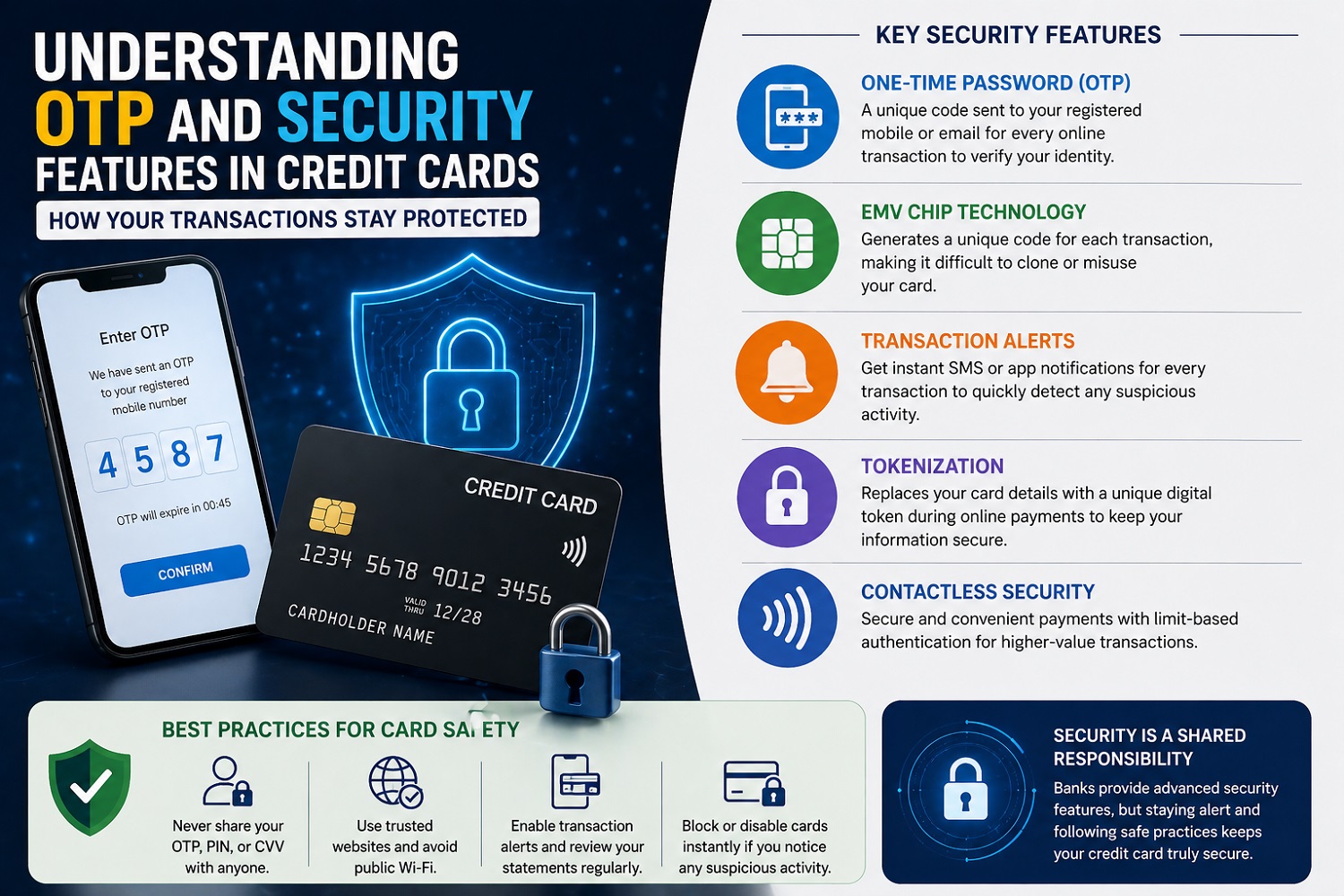
The use of a one-time password, or OTP, as a temporary code is very common as a security measure while making transactions in India. This code is always sent to your registered mobile number or email whenever you conduct an online transaction.
Actually, it acts as an additional layer of verification. The important part regarding it is even if someone has access to your card number, they cannot complete the transaction without the OTP.
Notably, this OTP-based authentication is widely used in India. It acts as part of the two-factor authentication (2FA). According to experts, this system makes digital payments more secure.
Built-in Security Features in Credit Cards
Apart from OTP, there are several built-in security features in credit cards that protect users.
The presence of an EMV chip is one of those most important security features. It creates a unique transaction code each time you use your card at a terminal. This is indeed a promising path that decreases the risk of card cloning.
Another key security feature is transaction alerts. In this process banks send instant SMS or app notifications for every transaction conducted through a credit card. This undeniably allows you to quickly detect any suspicious activity.
Moreover, many cards allow you to temporarily block or disable certain types of transactions like international payments or online purchases.
Tokenisation and Contactless Safety
Tokenisation is a new security feature. It replaces, or some say hides, your actual credit card details with a unique digital token when you do online transactions. It is a robust protection gate that ensures your sensitive information is not stored on merchant websites.
Contactless payments are also secured with limits. In addition, they are convenient too.
In the current scenario, transactions above a certain amount always require additional authentication. Without a doubt, this step diminishes the risk of misuse.
Best Practices for Card Safety
The above discussion has pointed out various notable OTP and security features in credit cards. However, despite strong protection ways, it is essential that you must remain cautious.
You must make sure that you never share your OTP, PIN, or CVV with anyone. There are umpteen past instances that showed how users received misleading and fake calls claiming they were from banks. Therefore, it is essential that you must not be the victim of this trap.
Furthermore, always use trusted websites. Also, avoid making transactions on public Wi-Fi networks.
Concluding words
So, one thing is very clear from the discussion: proper understanding of OTP and security features in credit cards helps you to use your card confidently and safely.
Remember banks provide multiple layers of protection. But still, you should stay alert and always follow basic security practices, as these are equally important to prevent fraud.